
If you’re building an online course platform, you need a way to organize content hierarchically: courses contain modules, modules contain lessons, lessons contain videos etc. WordPress hierarchies, categories and tags aren’t really built for this.
That’s where BricksMembers Content Structures come in.
This guide explains what structures are, why they’re better than categories, and how to use them to organize your membership content.
PS: Also watch our new tutorial on how to use content structure data in Bricks Builder: https://www.youtube.com/watch?v=Lsn55FA5UOc
What Are Content Structures?
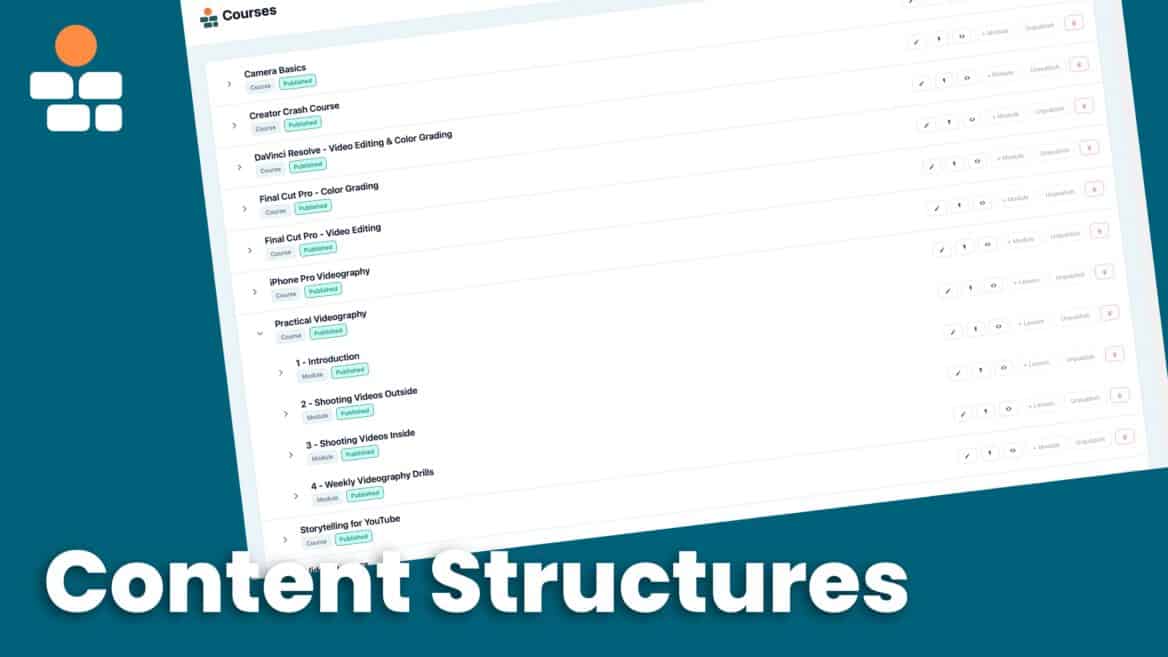
Content Structures let you organize posts hierarchically with move-buttons simplicity.
Example structure:
Course: WordPress Mastery
├── Module 1: Getting Started
│   ├── Lesson 1.1: Installing WordPress
│   ├── Lesson 1.2: Choosing a Theme
│   └── Lesson 1.3: Essential Plugins
├── Module 2: Building Pages
│   ├── Lesson 2.1: Introduction to Bricks
│   ├── Lesson 2.2: Creating Your First Page
│   └── Lesson 2.3: Responsive Design
└── Module 3: Advanced Topics
    ├── Lesson 3.1: Custom Post Types
    └── Lesson 3.2: Dynamic Data
Each item is a regular WordPress post. The structure defines the hierarchy and order.
Why Use Structures Instead of Categories?
WordPress Categories: Flat Organization
Categories are flat. A post can be in multiple categories, but there’s no inherent hierarchy or order.
Problems with categories:
- ❌ No clear parent-child relationships between posts (only between categories)
- ❌ Can’t easily reorder (no arrow buttons or visual controls)
- ❌ Hard to navigate per scope (no “next lesson” or “previous lesson” within course, module etc.)
- ❌ Bricks Query Loops etc. reach their limits quickly
WordPress Hierarchical Posts: Limited and Inflexible
WordPress supports hierarchical posts (like Pages), but this approach has significant limitations for course content:
Problems with hierarchical posts:
- ❌ No menu order control: Hierarchical posts are sorted alphabetically by title or by date, not by a custom sequence
- ❌ No simple reordering: You can’t easily reorder child posts within a parent with arrow buttons or visual controls
- ❌ Limited depth: Navigating deep hierarchies (Course → Module → Lesson → Video) becomes unwieldy in the admin
- ❌ No flexible level naming: Can’t customize what each level is called (e.g., “Module” vs “Section”)
- ❌ Can’t have multiple structures: A post can only have one parent, so you can’t organize the same content in different ways
- ❌ Performance issues: Querying hierarchical relationships becomes slow with many posts
Example problem: If you want Lesson 1.1 to come before Lesson 1.2, you’d have to name them “01 – Lesson 1.1” and “02 – Lesson 1.2” or manually set menu_order values in the database. There’s no simple interface with arrow buttons to move items up and down. There are plugins for that. But well, we want to reduce the amount of plugins as much as possible, right?
BricksMembers Structures: Purpose-Built for Courses
Structures are hierarchical. Each post has a specific parent and position in the sequence.
Benefits of structures:
- ✅ Guaranteed order (you control the sequence)
- ✅ Parent-child relationships between posts (lessons belong to modules etc.)
- ✅ Easy reordering with arrow buttons (move up/down) interface
- ✅ Easy navigation (next/previous within the structure)
- ✅ Progress tracking per structure
- ✅ Drip content based on structure position
Creating Your First Structure
Let’s create a simple course structure.
Step 1: Create the Structure
- Go to BricksMembers → Content Structures
- Fill in the Structure Name: Give it a unique name (e.g., “WordPress Mastery Course”)
- Choose the Number of Levels (2-6):
- 2 Levels: Course → Lessons
- 3 Levels: Course → Modules → Lessons
- 4 Levels: Course → Modules → Lessons → Topics
- 5+ Levels: For very complex structures
- These are just examples. Name them as you want.
- Progress Tracking Level (optional): Select which level should be tracked for completion (e.g., “Lessons”). Only visible if progress tracking is enabled in BricksMembers → Settings. You can still select that later, after creating the structure.
- Admin Menu Icon (optional): Choose a Dashicon for the WordPress admin menu (e.g., Book, Learn, Education). A preview of the selected icon is shown.
- Custom Permalink Slug (optional): Override the URL slug for this structure (e.g., use “course” instead of “my-course-type”). Leave empty to use the top-level post type slug. This will result in URLs like “/custom-slug/course-name/module-name/lesson-name”.
- Configure each level: For each level (e.g., Level 1, Level 2), fill in:
- Singular Name: How a single item is called (e.g., “Course”, “Module”, “Lesson”). The form is pre-filled with suggested names based on the number of levels.
- Plural Name: How multiple items are called (e.g., “Courses”, “Modules”, “Lessons”).
- Slug: URL-friendly name (e.g., “course”, “module”, “lesson”). The system validates slugs to prevent conflicts with existing structures.
- You can use the same slugs as you have for custom post types, to make existing posts available in your structure instantly (WP allows registering the same post type multiple times without errors). This is useful for migrations. So you don’t have to recreate all your existing posts.
- Click Create Structure at the bottom of the form
Your structure is created, but it’s empty. Let’s add content.
Step 2: Access Your Structure Admin Interface
After creating your structure, a new menu item appears in the WordPress sidebar (e.g., “Courses” or whatever you named your structure).
- Look in the WordPress sidebar for your structure name
- Click on it to open the structure admin interface
This interface shows all posts in your structure in a hierarchical tree view.
Step 3: Add Posts to Your Structure
To create posts in your structure, you must first enable Edit Mode:
- In the structure admin interface (from the WordPress sidebar), click Edit Mode in the top right
- The Add New [Post Type] button becomes active (e.g., “Add New Course”)
Creating Top-Level Posts
- With Edit Mode enabled, click the Add New [Post Type] button in the header
- A modal appears asking for the post title and optional content
- Enter your post title (e.g., “Introduction to WordPress”)
- Click Create
- The post is created and immediately appears in the structure tree view
Creating Child Posts (e.g., Modules or Lessons)
- With Edit Mode enabled, find the parent post in the tree (e.g., a Course)
- Click the + [Child Type] button next to it (e.g., “+ Module”)
- A modal appears with the parent relationship already set
- Enter the post title and optional content
- Click Create
- The child post appears under its parent in the tree view
Remember to Save
All posts created in Edit Mode are staged until you click Save Edits. This allows you to create multiple posts and organize them before saving everything at once.
Important Tip: After adding a few posts, save the edits to be safe. But instead of clicking the save edits button, hover over it and click on No Recompute to save time.
On a live site, recomputes are needed after doing any changes in the edit mode to ensure all content structure, progress, and drip data works correctly. But when setting up a new site, you only need to trigger those after the very last changes.
To do so, simply use the Save Edits button after your last round of edits, and all computations will happen directly. Alternatively, you can trigger them using the maintenance tools section under BricksMembers → Settings → Maintenance → Content Navigation Updates → Run.
They are important. Don’t leave them out or you will run into issues!
Step 4: Reorder Posts (Optional)
To change the order of posts in your structure, use Edit Mode:
- In the structure admin interface (from the WordPress sidebar), click Edit Mode in the top right
- Arrow buttons appear next to each post:
- ↑↑ Move to top
- ↑ Move up one position
- ↓ Move down one position
- ↓↓ Move to bottom
- Reorder posts as needed using these buttons
- You can also create, delete, publish, or unpublish posts while in Edit Mode
- Click Save Edits when done
All changes are applied at once, and the structure is recomputed only once (instead of after every individual change), what takes a few seconds, depending on the amount of posts. Progress bars appear to indicate the status.
Tips:
- Activate progress tracking and / or drip after you created all your structure posts and user levels to save computation time after every save edits click.
- If progress and / or drip is already activated, you can click “No recompute”, what shows up when you hover over the Save Edits button.
This skips the computations entirely to save time. But you do have trigger computations manually after all your changes are made, as otherwise you might get problems in the frontend.
To trigger recompilations, simply click Edit Mode and Save Edits directly, or via the Maintenance Tools on the BricksMembers Settings page.
Understanding Structure Levels
When you create a structure, you define how many levels it has. Here’s what each level means:
Level 2 Structure (Course → Lessons)
- Top level: Courses
- Level 2: Lessons
- Use case: Simple courses with no modules
Level 3 Structure (Course → Modules → Lessons) ⭐ Recommended
- Top level: Courses
- Level 2: Modules
- Level 3: Lessons
- Use case: Most online courses
Level 4 Structure (Course → Modules → Lessons → Videos)
- Top level: Courses
- Level 2: Modules
- Level 3: Lessons
- Level 4: Videos
- Use case: if you have multiple videos per lesson
Level 5-6 Structures
- For extremely complex hierarchies, like universities etc.
- Rarely needed
Edit Mode Explained
Edit Mode is a special mode for making multiple changes at once without triggering recomputation after every change. Recomputations are necessary after changes that can only be made in edit mode to ensure everything works correctly and super fast in the frontend. BricksMembers pre-calculates some data there to greatly simplify the logic in the frontend, what leads to better performance.
When to Use Edit Mode
Use Edit Mode when you need to:
- Create multiple posts at once
- Delete multiple posts
- Reorder many posts
- Change post status (publish/unpublish) for multiple posts
- Move posts between parents
How Edit Mode Works
- Go to BricksMembers → Content Structures
- Click Edit next to your structure
- Click Enter Edit Mode
- Make all your changes (create, delete, reorder, publish, unpublish)
- Click Save Edits
All changes are applied at once, and the structure is recomputed only once (instead of after every change).
Outside Edit Mode:
- You can view, edit (content), and quick edit posts
- You CANNOT create, delete, reorder, or change status
- This prevents accidental changes without recomputations or annoying computations after every little change
Inside Edit Mode:
- You can do everything
- Changes are staged locally
- Nothing is saved until you click “Save Edits”
Example: Creating a New Course
- Enter Edit Mode
- Click Add New Post → “Module 1: Getting Started”
- Click Add New Post → “Lesson 1.1: Installing WordPress” (parent: Module 1)
- Click Add New Post → “Lesson 1.2: Choosing a Theme” (parent: Module 1)
- Click Add New Post → “Module 2: Building Pages”
- Click Add New Post → “Lesson 2.1: Introduction to Bricks” (parent: Module 2)
- Click Save Edits
All 5 posts are created, the structure is computed, and progress/drip are updated—all in one operation.
Structure Path Computation
Behind the scenes, BricksMembers computes a “structure path” for each post. This is a JSON field that stores:
- The post’s position in the hierarchy
- Its parent and ancestors
- Its order number
- Boundary information (for fast child lookups)
You don’t need to understand the technical details. Just know that:
- Structure paths are computed automatically
- They make navigation and progress tracking fast
- They’re updated when you reorder posts
Using Structures with Other Features
Progress Tracking
When Progress Tracking is enabled, you can track progress per structure.
Example:
- User completes 5 out of 10 lessons in “WordPress Mastery Course”
- Progress: 50%
- Display with:
{brm_progress:percent:structure}dynamic tag
Drip Content
Structures work perfectly with drip content.
Example:
- Unlock lessons one per week, in order
- Require previous lesson completion before unlocking the next
- Use structure boundaries to define “previous within this module”
Navigation
Use the BricksMembers Post Navigation element to show next/previous links within the structure.
Example:
- On “Lesson 1.2,” show:
- Previous: “Lesson 1.1”
- Next: “Lesson 1.3”
- Automatically respects structure boundaries, like don’t show lessons of the next course, module, or whatever you set as boundary.
Query Loops
Filter Bricks query loops to show only posts within a structure (“Within Structure Boundary” – filter).
Example:
- Show all videos in the current lesson
- Show all lessons in the current module
- Show all modules in the current course
Best Practices
Naming Conventions
Good:
- “Module 1: Getting Started” (clear, numbered)
- “Lesson 1.1: Installing WordPress” (hierarchical numbering)
- “WordPress Mastery Course” (descriptive structure name)
Avoid:
- “Lesson 1” (not descriptive enough)
- “The first lesson in the module about WordPress basics” (too long)
Structure Depth
Recommended: Level 3 (Course → Module → Lesson)
Too shallow: Level 2 (Course → Lesson)
- Hard to organize large courses
- No logical grouping
Too deep: Level 5+ (Course → Section → Module → Lesson → Topic → Subtopic)
- Overwhelming for users
- Hard to navigate
Good, deep example: Level 6 (Topic → Course → Section → Module → Lesson → Video)
Common Questions
Q: Can a post be in multiple structures?
A: No. Each post belongs to one structure (or none). This ensures clear hierarchy and prevents confusion.
Q: Can I change a post’s parent after creation?
A: Yes. Edit the post and change the BRM Parent Level field, or move it to a new parent in the structure interface using the arrow buttons.
Q: What happens if I delete a parent post?
A: Its children become orphaned. You’ll need to reassign them to a new parent or delete them. If they’re not visible, click the Show Hidden button. The same goes for trashed and unpublished posts.
Q: I can’t see certain posts in the list. How do I find them?
A: They’re likely parentless, trashed, or unpublished. Click the Show Hidden button to let them appear.
Q: Can I export/import structures?
A: Not currently. This is planned for a future update.
Q: Do structures work with custom post types?
A: Yes! Structure posts are all custom post types. By using the same slugs as registered custom posts, the already existing posts in the post type can be used in content structures.
Q: Can I have multiple structures for the same post type?
A: No, but you can create multiple courses or generally top level posts within one structure, and you’re not forced to fill each one to the bottom level. So in the same structure, you can have courses that go as deep as level 4 (video) and others that only go as deep as level 3 (lesson). Just track progress on the lesson level in that case.
Q: How do I delete a structure?
A: Go to BricksMembers → Content Structures, click Delete next to the structure. The posts remain, but the structure hierarchy is removed.
Next Steps
Watch our tutorial on how to use content structures in Bricks Builder:
Now that you understand content structures, you’re ready to:
- Set up progress tracking – Track completion per structure
- Configure drip content – Release lessons over time within structures
- Build navigation – Use the Post Navigation element for next/previous links